
 Talk to a virtual agent


Useful Information
Jaw Crusher: Fully Electric or Diesel?

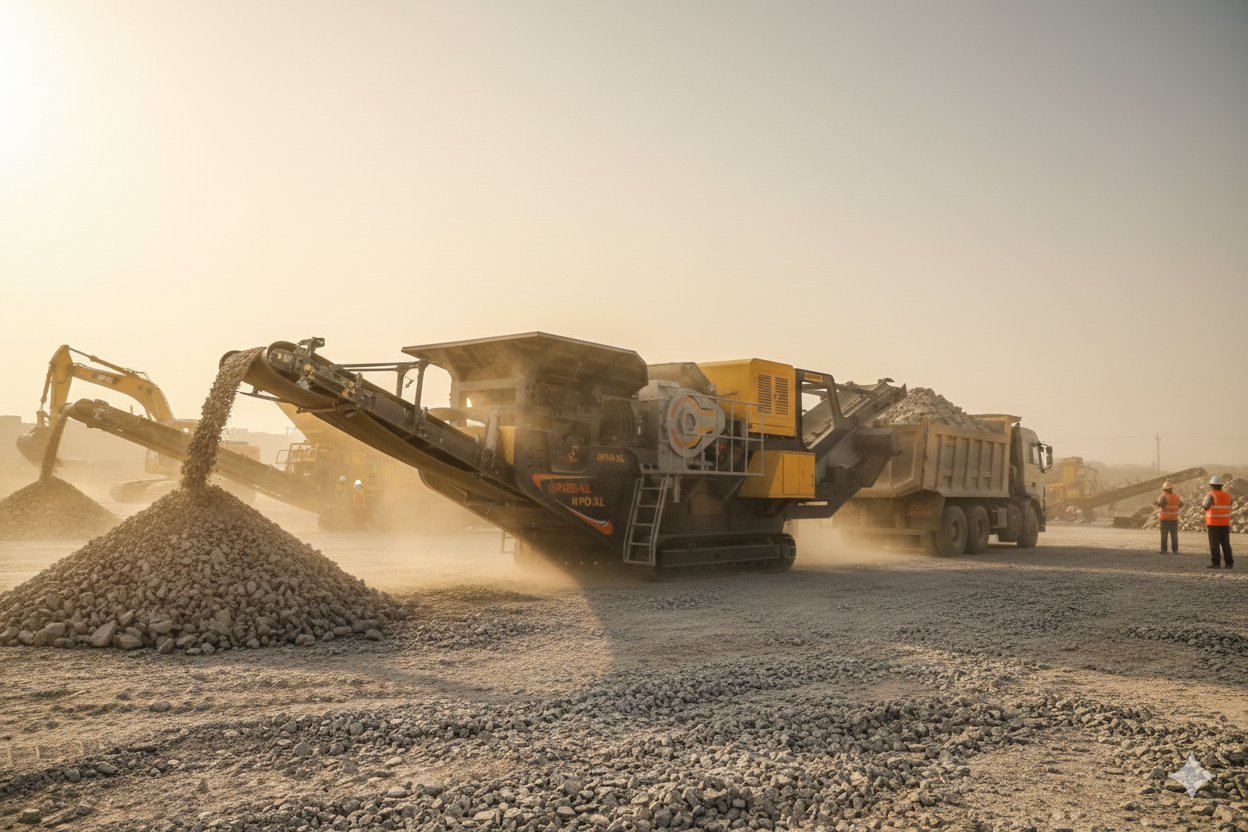
If you’re looking for a jaw crusher and can’t decide between the electric and diesel versions, you’ve come to the right place. This decision can mean tens of thousands of euros saved or wasted over the machine’s service life. In 2026, the Romanian market offers solutions for every kind of operation – from urban demolition to massive quarries – but the wrong choice can hurt your profitability for years.
We analyzed both options using real data from the Romanian market, verified costs and concrete recommendations based on hands-on experience. No marketing, no clichés.
If you have access to 380V power, the electric jaw crusher almost always wins in the long run – 30–40% lower consumption, zero emissions, simple maintenance. If you work in completely isolated areas, diesel remains indispensable.

🔩 1. What is a jaw crusher?
A jaw crusher is an industrial machine designed to break down hard materials: rock, granite, basalt, concrete, asphalt, brick or ceramics. It works on the principle of compression: material entering through the feed opening is progressively crushed between a fixed jaw and a moving jaw, which is driven eccentrically by a shaft and flywheel.
The result is granular material of a controlled size (adjustable by changing the gap between the jaws) that can be used in construction as fill, foundation or drainage material, or sold as natural aggregate. Jaw crushers are among the most widely used machines in mining, construction and inert waste recycling.
Main types of jaw crushers available in Romania
- Stationary (fixed) jaw crusher – permanently anchored in a plant and electrically powered. Ideal for quarries and processing plants with large, steady volumes.
- Mobile tracked jaw crusher – moves around the site under its own power, diesel or hybrid. Maximum flexibility on any terrain.
- Compact electric jaw crusher – 230V or 380V three-phase, for demolition in tight spaces, urban recycling and sites with a power connection.
- Dual-power hybrid crusher – runs on both electricity and diesel. This is the industry’s dominant direction in 2026.
Romania has one of the most active construction and infrastructure markets in Central and Eastern Europe. The construction sector has benefited massively from EU funds through the PNRR (National Recovery and Resilience Plan), which has driven up demand for crushing and recycling equipment. Distributors active on the local market include BM Romania (Sandvik), IRCAT (Powerscreen), Utilben (Evoquip), Nordmann and magazinuldeutilaje.ro.
⚡ 2. The electric jaw crusher – Advantages and disadvantages
Electric jaw crushers have gained significant ground in recent years, driven by rising diesel prices, the EU Stage V emission regulations and the general trend toward electrifying heavy industry. Sandvik recently launched the fully electric UJ443E, which, according to the manufacturer, cuts consumption by up to 30% compared with the previous diesel generation.
- 30–40% lower consumption than diesel
- Low noise (55–72 dB vs. 90–110 dB for diesel)
- Zero local emissions – can be used indoors and in urban areas
- Instant start-up, no warm-up time
- Minimal maintenance – no oil filters, injection system or turbo
- Lower operating costs in the long run
- Compatible with solar or wind power
- Less vibration than diesel engines
- Requires a 380V three-phase connection
- Limited mobility in areas without infrastructure
- Vulnerable to power outages
- Sometimes a higher upfront cost
- Requires a switchboard and dedicated protection devices

⛽ 3. The diesel jaw crusher – Advantages and disadvantages
Diesel jaw crushers remain the heavy-industry standard wherever absolute mobility is essential. Engines from Caterpillar, Cummins, Perkins or Volvo deliver consistent power regardless of location. Popular diesel models on the Romanian market include the Powerscreen Premiertrak, Sandvik QJ341 and Beyer Evortle CT850 with a 150 hp CAT or Perkins engine.
- Complete mobility – works anywhere, no infrastructure needed
- High power available (50–600+ hp)
- High throughput – up to 1,000+ t/h
- Ideal for quarries, mines and remote mountain areas
- Self-propelled on tracks
- Spare parts widely available in Romania
- High fuel consumption – 20–60+ liters/hour
- CO₂, NOx and fine particulate emissions – urban restrictions
- High noise (90–110 dB)
- Complex and costly maintenance
- Mandatory Stage V compliance in the EU
- Warm-up time at low temperatures
📊 4. Full comparison: electric vs diesel jaw crusher
| Criterion | ⚡ Electric | ⛽ Diesel |
|---|---|---|
| Mobility | Medium – needs a cable/genset | Excellent – fully self-sufficient |
| Energy consumption | –30–40% vs. diesel | 20–60+ L/hour |
| Cost/tonne processed | ~0.50–0.90 RON/t | ~1.50–2.50 RON/t |
| Noise | 55–72 dB | 90–110 dB |
| Local emissions | Zero | CO₂, NOx, PM |
| Indoor use | YES ✓ | NO ✗ |
| Remote areas | Limited | Ideal ✓ |
| Maintenance cost | Low | Medium–High |
| EU environmental compliance | No restrictions | Stage V mandatory |
| Renewable energy | Compatible | NO |
| Return on investment | 12–24 months faster | Standard |
💶 5. Prices and operating costs in 2026
Indicative jaw crusher prices (2026)
| Jaw crusher type | New price (€) | Used (€) |
|---|---|---|
| Compact electric (2–5 kW, 1–3 m³/h) | 3,000 – 9,000 | 1,500 – 4,500 |
| Mid-size electric (30–75 kW, 50–150 t/h) | 15,000 – 65,000 | 8,000 – 32,000 |
| Industrial electric 150 t/h – OP150-EL | 75,000 – 120,000 | 30,000 – 60,000 |
| Small mobile diesel (50–80 hp, ~30 t/h) | 25,000 – 65,000 | 12,000 – 32,000 |
| Mid-size mobile diesel (150 hp, ~130 t/h) | 80,000 – 200,000 | 35,000 – 95,000 |
| Large mobile diesel (300–600 hp, 500+ t/h) | 200,000 – 450,000 | 80,000 – 200,000 |
The real cost per tonne – electric vs diesel
For a 150 t/h crusher, the comparison looks like this:
The 150 hp diesel version: consumption ~28 L/hour × 7 RON/L = 196 RON/hour → ~1.30 RON/tonne (fuel only). Add a service every 250 hours (~2,500 RON), oil changes, filters and injection pump work, and you easily reach 1.80–2.50 RON/tonne in total.
The 110 kW electric version: consumption ~105–115 kWh per hour × 0.65 RON/kWh = ~72 RON/hour → ~0.48 RON/tonne. With minimal maintenance, the total comes to ~0.60–0.80 RON/tonne.
Electric: ~0.70 RON/t × 250,000 t = 175,000 RON in operating costs
Diesel: ~2.00 RON/t × 250,000 t = 500,000 RON in operating costs
Savings: ~325,000 RON (≈65,000 €) over 5 years – more than the purchase price!
🔍 6. Case study: OP150-EL Electric Jaw Crusher
The best example of a fully electric tracked jaw crusher currently available on the Romanian market is the OP150-EL from Ornate, available at magazinuldeutilaje.ro. Weighing 35 tonnes and with a capacity of 150 t/h, this machine proves that serious industrial performance is fully compatible with electric drive.
| Technical specification | OP150-EL value |
|---|---|
| Production capacity | up to 150 t/h |
| Machine weight | 35 t |
| Drive type | Fully electric (380V three-phase) |
| Travel system | Steel tracks – fully self-propelled on site |
| Feed opening | 1,050 × 700 mm |
| Max. feed size | 860 mm |
| Local emissions | Zero |
| Noise level | Significantly below the diesel equivalent |
| Availability | In stock – delivery in Romania |


🏗️ 7. Use scenarios – When to choose which type
- You work indoors or in semi-enclosed spaces
- You’re in urban areas with noise restrictions
- You have a 380V three-phase connection available
- You recycle concrete and brick or do demolition work
- You want the lowest cost per processed tonne
- You run a fixed or semi-fixed aggregate plant
- Environmental compliance is a priority
- You work in quarries or mines with no power supply
- You need complete, self-sufficient mobility
- Your projects are short and spread across multiple locations
- You work in hard-to-reach mountain areas
- You need continuous 24/7 operation
- A stable power connection isn’t an option for you
Dual-power models (diesel + electric) run on mains power when you have a connection (lowest cost, zero emissions) and switch automatically to diesel at remote sites. The Sandvik UJ443E, Powerscreen Premiertrak 420E and OP150-EL are relevant examples. This is the smart investment for companies with varied job sites.
🎯 8. How do you choose the right jaw crusher? A complete checklist
Before you sign a contract or pay a deposit, go through every point honestly:
- A clearly defined work location – indoor/urban → electric is a must; remote site → diesel or hybrid
- Access to 380V three-phase power – if yes, electric wins hands down on TCO
- Estimated monthly volume – under 500 t: compact electric; 1,000–10,000 t: mid-size electric; over 10,000 t: industrial
- How often you change location – weekly → diesel/hybrid; rarely or fixed → electric
- Material type – granite/basalt wears the jaws 3× faster than limestone or concrete
- A calculated 5-year total budget – purchase + energy + maintenance + jaws (2,000–8,000 €/set)
- Local noise/emission requirements – urban or residential areas, or close to water → electric is a must
- Local service available – check whether there is an authorized dealer/service center in your county
⭐ 9. What customers say about jaw crushers
❓ 10. Frequently asked questions about jaw crushers
Looking for the right jaw crusher for your project?
The magazinuldeutilaje.ro team offers free advice and a tailored quote for any type of crusher – electric, diesel or hybrid. Fast delivery throughout Romania, warranty and after-sales technical support.
